Salon GST Cut to 5%: What the 2025 Change Really Means for Your Margins
India cut GST on salon, spa and wellness services from 18% to 5% (without input tax credit) on 22 September 2025. Here is what actually changes for your bills, your margins, and your pricing — and why the real saving is closer to 2.5% than 13%.
free trial · No credit card required · Setup in 10 minutes
Key Takeaways
- Salon services now attract 5% GST (2.5% CGST + 2.5% SGST) without input tax credit — mandatory since 22 September 2025.
- The real benefit to clients is around 2.5%, not the headline 13%, because salons lost the ITC that offset their input costs.
- Your billing must switch from 18% to 5% immediately — 18% invoices now over-charge clients and produce wrong returns.
- Retail products are unaffected: they keep their own HSN rates (commonly 5–18%) and must be billed as separate lines.
What Actually Changed on 22 September 2025?
At its 56th meeting, the GST Council recommended cutting GST on beauty and physical well-being services — salons, spas, barbers, gyms, yoga and fitness centres — from 18% to 5%. The Central Board of Indirect Taxes and Customs (CBIC) confirmed the new rate is mandatory and applies without input tax credit, effective 22 September 2025. Service providers no longer have the option to charge 18% with ITC.
In plain terms: on every service bill from 22 September 2025, the GST line drops from 18% to 5% — split as 2.5% CGST and 2.5% SGST for a same-state transaction. If your bills or software still show 18%, they are now wrong.
Source: Press Information Bureau — FAQs on the decisions of the 56th GST Council.
Why the Real Saving Is ~2.5%, Not 13%
A drop from 18% to 5% looks like a 13% price cut. It isn't — because the 5% rate comes without input tax credit. Under the old regime, salons could offset the GST they paid on rent, products and equipment. That credit is now gone, so those costs rise and most salons lift their base price slightly to protect margin. The industry body BWAI lays out the arithmetic:
| On a ₹100 service | Before (18% + ITC) | After (5%, no ITC) |
|---|---|---|
| Base service price | ₹100 | ₹110 (to cover lost ITC) |
| GST | ₹18 (18%) | ₹5.50 (5%) |
| Client pays | ₹118 | ₹115.50 |
In this example the client saves ₹2.50 on a ₹118 bill — about 2% — and BWAI puts the typical net benefit at roughly 2.5%, nowhere near the headline 13%. That is the honest range to plan around. It is still a genuine reduction, and a real reason to tell clients their bills are lower — but if you drop your prices by the full 13% you will hand away the margin the lost ITC already took from you.
Source: BWAI, via Professional Beauty India — GST structure change and its impact on salons.
What Losing Input Tax Credit Actually Costs You
Under 5% without ITC, the GST embedded in these everyday costs can no longer be offset — it stays on your P&L.
Shop rent
GST on commercial rent is no longer creditable against your service tax.
Retail stock for professional use
GST on products you consume in services becomes a straight cost.
Electricity-linked equipment & fittings
GST on chairs, dryers, AC units and fit-outs can no longer be offset.
Software & marketing subscriptions
GST on the tools you run the business on is now an expense, not a credit.
Professional consumables
Colour, wax, disposables — the GST embedded in them stays with you.
What Salon Owners Should Do Now
Four practical moves to stay compliant, protect your margin, and turn the rate cut into a booking opportunity.
Reprice your menu as GST-inclusive
Because you have lost input tax credit, your true cost of delivering a service is slightly higher than the headline 13% drop suggests. Decide your GST-inclusive menu price deliberately — many salons hold prices steady and pass on a real ~2.5% saving, rather than dropping the full 13% and eroding margin.
Switch your billing to the 5% rate
Every invoice from 22 September 2025 must show 5% GST (2.5% CGST + 2.5% SGST) on services — not 18%. If your software still applies 18%, you are over-charging clients and filing wrong returns. In SalonBoost this is a one-time setting; every bill then applies 5% automatically.
Separate product sales from service lines
Services are 5% without ITC; retail products keep their own HSN rates (commonly 5–18%). Bill them as separate line items so your returns are correct and your product margins stay visible.
Tell your clients about the lower price
A visible GST cut is a marketing moment. A short WhatsApp note — 'Our GST is now 5%, so your bill is lower' — turns a tax change into a reason to book. SalonBoost can send this to your whole client list in one campaign.
How SalonBoost Handles the 5% Change
Correct 5% on every bill
Set the service GST rate once — SalonBoost applies 5% with the 2.5% CGST + 2.5% SGST split automatically on every invoice, so no bill goes out at the old 18%.
Products billed separately
Services stay at 5% while retail products carry their own HSN rate on separate lines, keeping both your returns and your product margins clean.
Monthly GST summary for your CA
One report shows service revenue, product revenue and GST collected — everything your CA needs to file GSTR-1 and GSTR-3B correctly under the new rate.
Tell clients in one campaign
Announce your lower GST to your whole client list over WhatsApp — turning a tax change into a reason to rebook.
Bill the New 5% Rate the Right Way
SalonBoost Essential at ₹799/month includes full GST billing at the current 5% rate. free trial, no credit card needed.
Salon GST 5% Cut — Common Questions
Related Resources
Salon GST Billing Guide →
The full guide: 5% rate, SAC codes, CGST/SGST invoice format, registration and monthly returns.
Salon Pricing Strategies →
How to set GST-inclusive prices that protect margin without losing clients.
Salon Billing Software →
GST billing at the current 5% rate with UPI, card and cash modes and WhatsApp dispatch.
SalonBoost Pricing →
Essential ₹799/mo · AI Growth ₹1,499/mo. No setup fees, no commissions.
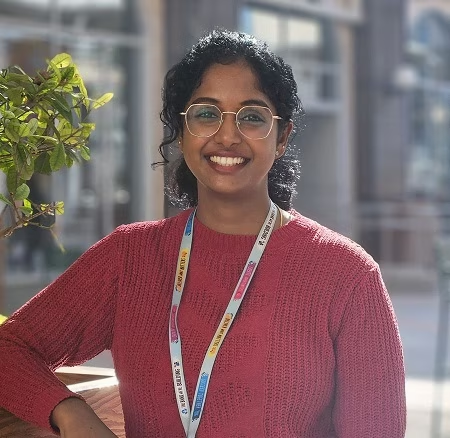
Founder & CEO, SalonBoost
Swetha has helped 500+ Indian salons and spas streamline operations with SalonBoost salon management software. She writes about salon growth strategies, WhatsApp automation, and the Indian beauty industry.