A salon website has one job: convert visitors into bookings. Not “showcase your brand,” not “display your portfolio” — those are means, not ends. Every design decision should be evaluated by whether it moves visitors closer to or further from the booking action.
Google’s own research consistently shows that website performance (speed, mobile usability, clear CTAs) is more important than visual sophistication. A beautiful website that loads in 5 seconds loses 90% of visitors before they see the design. A fast, clear website with a prominent booking button outperforms a visually stunning one every time.
6 Salon Website Conversion Killers (and How to Fix Each One)
These aren’t aesthetic preferences — each is backed by user behaviour data with specific impact measurements:
No online booking widget above the fold
Impact: Loses 40–60% of ready-to-book visitors
The Research
Google/Ipsos (2019): 53% of mobile users abandon sites that take > 3 seconds to load; similarly, if the booking action requires scrolling, mobile users bounce. The booking CTA must be visible without scrolling.
Fix
Sticky 'Book Now' button on mobile, booking widget or CTA within 600px of page top on desktop.
Phone number as only booking method
Impact: Loses 60–70% of after-hours visitors
The Research
Zenoti (2023): 41% of online salon bookings happen outside business hours. A phone-only booking method means 41% of booking-intent visitors hit a dead end. GetApp (2024): 67% of clients prefer booking online over calling.
Fix
24/7 online booking widget + WhatsApp chat link (for clients who prefer messaging over forms).
No prices on the website
Impact: Loses 30–50% of comparison shoppers
The Research
BrightLocal (2024): 78% of consumers say they want to see pricing on a business website before contacting. Hiding prices creates uncertainty — and uncertain visitors leave, not call. The exception: ultra-premium salons where price is genuinely bespoke (e.g., corrective colour work).
Fix
Display starting prices for every service category. Use 'from $X' if prices vary by stylist level or hair length.
Slow page load speed (> 3 seconds)
Impact: Loses 32% of visitors per extra second
The Research
Google/SOASTA (2017): probability of bounce increases 32% as page load time goes from 1 to 3 seconds, and 90% from 1 to 5 seconds. Portent (2022): conversion rate drops 4.4% for each additional second of load time.
Fix
Compress images (WebP/AVIF format), minimise JavaScript, use lazy loading for below-fold images. Target: LCP < 2.5s, FID < 100ms, CLS < 0.1 (Core Web Vitals thresholds).
No Google reviews or testimonials visible
Impact: Loses trust with 88% of visitors
The Research
BrightLocal (2024): 88% of consumers trust online reviews as much as personal recommendations. A salon website without visible social proof forces visitors to leave your site and check Google — and they may find a competitor first.
Fix
Embed Google review widget or display testimonials with client name and photo. Link to your Google profile for full reviews.
No mobile responsiveness
Impact: Loses 70%+ of traffic (mobile is majority)
The Research
Statcounter (2025): mobile accounts for 59% of global web traffic, higher for local service searches. Google (2018): 61% of users are unlikely to return to a mobile site they had trouble accessing. Google also uses mobile-first indexing — your mobile experience IS your SEO ranking factor.
Fix
Mobile-first design (design for phone first, then expand to desktop). Test on actual devices, not just browser resize.
The 5-Page Salon Website Architecture
Salon websites don’t need 20 pages. Research on information architecture (Krug, Don’t Make Me Think, 3rd ed.) shows that simpler site structures with fewer navigation options convert better — because visitors don’t have to think about where to go. Five pages cover every client need:
Homepage
Purpose: First impression + routing to booking
Must-Have Elements
- Hero with value proposition + CTA (Book Now)
- 3–5 service categories with photos
- Trust signals (review count, years in business, certifications)
- Team preview (1 photo, not full bios)
- Location + hours + map embed
Services Page
Purpose: Education + pricing + conversion
Must-Have Elements
- Every service with name, description, duration, and starting price
- Service photos (real results, not stock images)
- CTA on each service → booking with service pre-selected
- FAQ per service category (answering 'does this work for my hair type?')
Team/About Page
Purpose: Trust building + stylist selection
Must-Have Elements
- Professional photo per stylist (consistent style)
- Specialty/expertise per person
- Certifications and training
- Optional: booking link per stylist (clients choose their person)
Gallery/Portfolio
Purpose: Visual proof of skill
Must-Have Elements
- Categorised by service type (colour, cuts, bridal, etc.)
- Before/after comparisons
- High-quality, consistently lit photos
- Each image links to the corresponding service booking page
Contact/Location
Purpose: Remove friction for visiting
Must-Have Elements
- Embedded Google Map
- Exact address with landmarks for navigation
- Hours (including holiday schedules)
- Phone, WhatsApp, and email
- Parking information (hugely underrated — parking anxiety prevents visits)
Core Web Vitals: The Performance Targets Your Salon Website Must Hit
Google uses Core Web Vitals as a ranking factor since 2021. Meeting these thresholds improves both SEO rankings and conversion rates:
| Metric | What It Measures | Good | Poor | How to Fix |
|---|---|---|---|---|
| LCP | Largest Contentful Paint — when the main content loads | ≤ 2.5s | > 4.0s | Compress hero image (WebP/AVIF), preload critical fonts, use CDN |
| INP | Interaction to Next Paint — responsiveness to clicks/taps | ≤ 200ms | > 500ms | Minimise JavaScript, defer non-critical scripts, avoid render-blocking resources |
| CLS | Cumulative Layout Shift — visual stability (things jumping around) | ≤ 0.1 | > 0.25 | Set explicit width/height on all images, reserve space for ads/embeds, preload fonts |
Test your site: Enter your URL at pagespeed.web.dev (Google’s official tool). It measures all three metrics and provides specific fix recommendations. For salon websites, the #1 offender is usually uncompressed hero images — converting from JPG/PNG to WebP or AVIF typically cuts LCP by 40–60%.
Local SEO: The Website Elements That Drive “Salon Near Me” Rankings
Moz’s annual Local Search Ranking Factors study (2023) identifies the top on-site signals for local pack and organic local rankings:
NAP consistency
Name, Address, Phone number — identical everywhere (website, Google Business, directories)
Why it matters: Google cross-references NAP across the web. Inconsistency (e.g., 'St.' on website, 'Street' on Google) reduces confidence in your listing.
Location pages
If you serve multiple areas, create a page per area with unique content (not just city name swapped)
Why it matters: Each location page targets 'salon in [city]' queries. Duplicate content across location pages gets filtered by Google.
Schema markup
LocalBusiness JSON-LD schema with address, hours, services, and geo-coordinates
Why it matters: Helps Google understand your business type, service area, and hours. Enables rich results (stars, hours, price range) in search.
Google Map embed
Embedded Google Map on your contact page showing your exact location
Why it matters: Sends a geo-signal to Google and helps clients find you. Also reduces bounce rate (visitors get the information they need without leaving).
Local content signals
Mention your city/neighbourhood naturally in page content, title tags, and meta descriptions
Why it matters: On-page location signals combined with Google Business Profile location create a strong local relevance signal.
2026: AI and Emerging Tools for Salon Websites
AI Chatbots for Booking Assistance
Chat widgets (Tidio, Intercom, WhatsApp Business) that answer common questions (pricing, availability, services) and guide visitors to booking. Reduces the “I have a question but don’t want to call” drop-off — which accounts for 20–30% of visitors.
No-Code Website Builders with Booking
Platforms like Squarespace, Wix, and GoDaddy with built-in booking widgets + payment processing. No developer needed. Template-based, but with customisation for brand colours, fonts, and imagery. Cost: $15–$40/month including hosting.
AI Search / GEO Optimisation
As AI search (ChatGPT, Perplexity, Google AI Overviews) grows, salon websites need structured, citable content that AI can reference. FAQ sections, service descriptions with specific details, and schema markup become more important — they’re the content AI search engines extract and cite.
AI-Powered A/B Testing
Tools that automatically test headlines, CTA positions, and page layouts — converging on the highest-converting version without manual experiment setup. Currently available in enterprise platforms (Optimizely, VWO); simpler versions are reaching SMB website builders.
See How Online Booking Drives Website Conversions
Watch a live demo of online booking widgets, WhatsApp integration, and the booking flow that converts website visitors into salon clients.
Frequently Asked Questions
Related Reading
5-level maturity model and 90-day roadmap for going digital
Social Media Marketing →5 content types and the Content-to-Booking Funnel
Salon Brand Building →Brand equity pyramid — your website must match your brand
Salon Management Software →Online booking, WhatsApp integration, and CRM
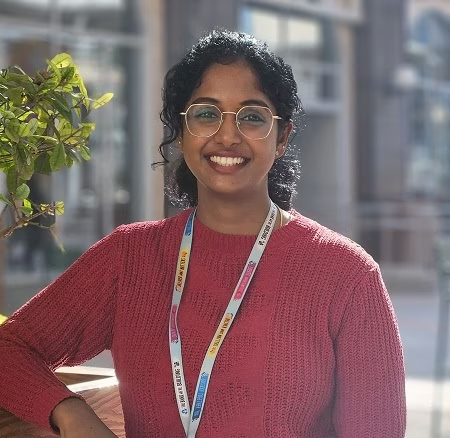
Founder & CEO, SalonBoost
Swetha has helped 500+ salons and spas streamline operations with SalonBoost salon management software. She writes about salon growth strategies, WhatsApp automation, and the Indian beauty industry.